- Sectors
- Aerospace & Defense
- Big science
- Fintech
- Insights
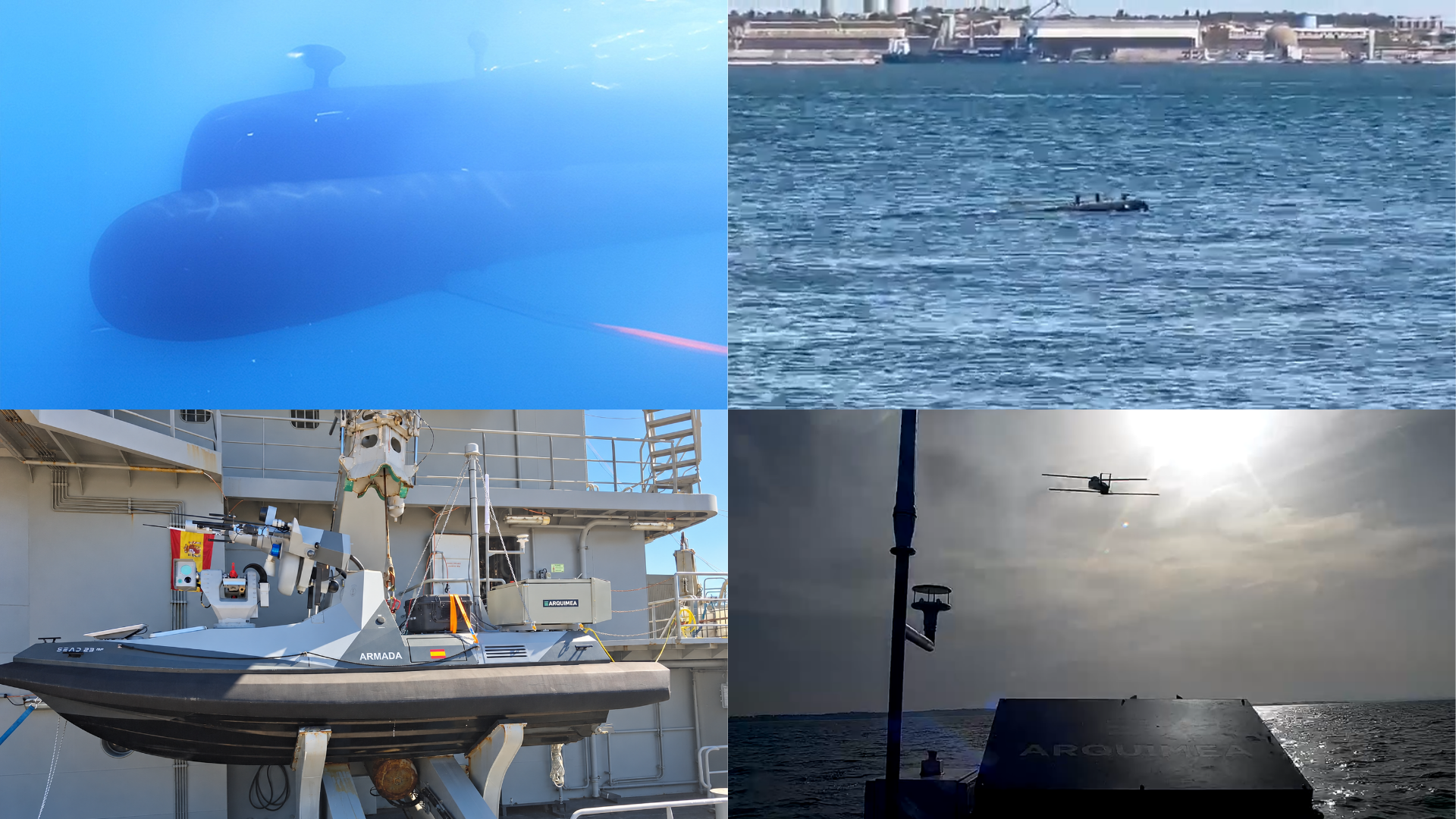
Tróia, 23 September 2026. ARQUIMEA, a European technology company specialised in autonomous systems for defence and security, with more than 20 years of experience, is participating in REPMUS26 (Robotic Experimentation and Prototyping with Maritime Unmanned Systems), held in Portugal throughout September. The Spanish technology company is taking part with two of its autonomous systems: the S-WISE hybrid autonomous surface and underwater system and the Q-SLAM-40 loitering munition integrated into a launcher system.
Coordinated with the Portuguese Navy, REPMUS26 brings together more than 130 companies and participants from 36 countries and their respective navies, as well as NATO organisations, universities and research centres.
During REPMUS26, ARQUIMEA has tested its S-WISE hybrid autonomous surface and underwater system, which has successfully completed a range of operational scenarios. The activities and capabilities demonstrated included participation in exercises involving the defence and attack of port facilities, the autonomous detection and tracking of vessels through the use of a 100% Spanish-developed neural network, and the deployment of infiltration capabilities in guarded facilities.
S-WISE’s participation in REPMUS26 enabled the system’s underwater flight concept to be validated in a real operational environment, together with its surface stability under different sea conditions. The exercise also demonstrated the feasibility of an underwater vehicle manufactured using acoustically transparent 3D-printed plastics, providing a high degree of resilience during missions and a high level of discretion, thanks to its low acoustic and visual signature, both on the surface and underwater.
During the exercise, the system demonstrated a high level of repairability under operational conditions and excellent communications performance, using both radio frequency (RF) and 4G/5G networks. This enabled the real-time transmission of video and AI-generated detections within the operational environment.
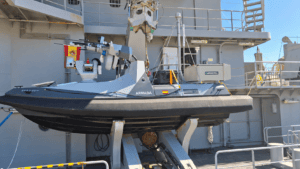
ARQUIMEA also participated in REPMUS26 with the Q-SLAM-40 loitering munition, integrated into an unmanned surface vehicle operated by the Spanish Navy. The system successfully carried out a mission from the platform offshore, completing all the stages of the operation: remote activation, launch, establishment of communications—including the real-time transmission of data and video with the Navy’s systems—navigation and arrival at the target.
The system operated successfully within the NAIAD / SCOMBA NG ecosystem, under NATO STANAG 4817.
This exercise demonstrated the Q-SLAM-40’s ability to be integrated with unmanned naval platforms and command-and-control systems. The operation confirms the system’s flexibility to be deployed from different platforms and used in autonomous missions across multidomain environments.
ARQUIMEA’s participation in REPMUS26 highlights the ability of its systems to operate in coordination with other platforms and networks, an essential capability for the future of naval operations and multidomain defence. The exercise also provided a realistic environment in which to assess emerging technologies, improve interoperability and validate operational procedures.
“REPMUS26 has been an exceptional opportunity to demonstrate the performance of our solutions in demanding operational scenarios. Both S-WISE and Q-SLAM-40 successfully completed their respective missions, confirming their ability to operate, communicate and interoperate with allied defence platforms and systems,” said Manuel Martín, General Manager of Defence at ARQUIMEA.
Through its participation in the exercise, ARQUIMEA strengthens its position as a European leader in autonomous systems for the naval and aerial domains and contributes to the development of new capabilities for Armed Forces that are more connected, interoperable and prepared to address the defence challenges of the future.
REPMUS is a key international event for the experimentation and prototyping of maritime unmanned systems within the NATO framework. The exercises carried out during REPMUS are essential for assessing the performance of autonomous systems in demanding operational scenarios that closely replicate real-world conditions. These tests make it possible to validate technologies, improve interoperability between platforms and systems from different countries, refine operational procedures and obtain key information for integrating new capabilities into the Armed Forces.
They also promote collaboration between navies, international organisations, industry, universities and research centres, accelerating the development of solutions for maritime defence and security.