- Sectors
- Aerospace & Defense
- Big science
- Fintech
- Insights
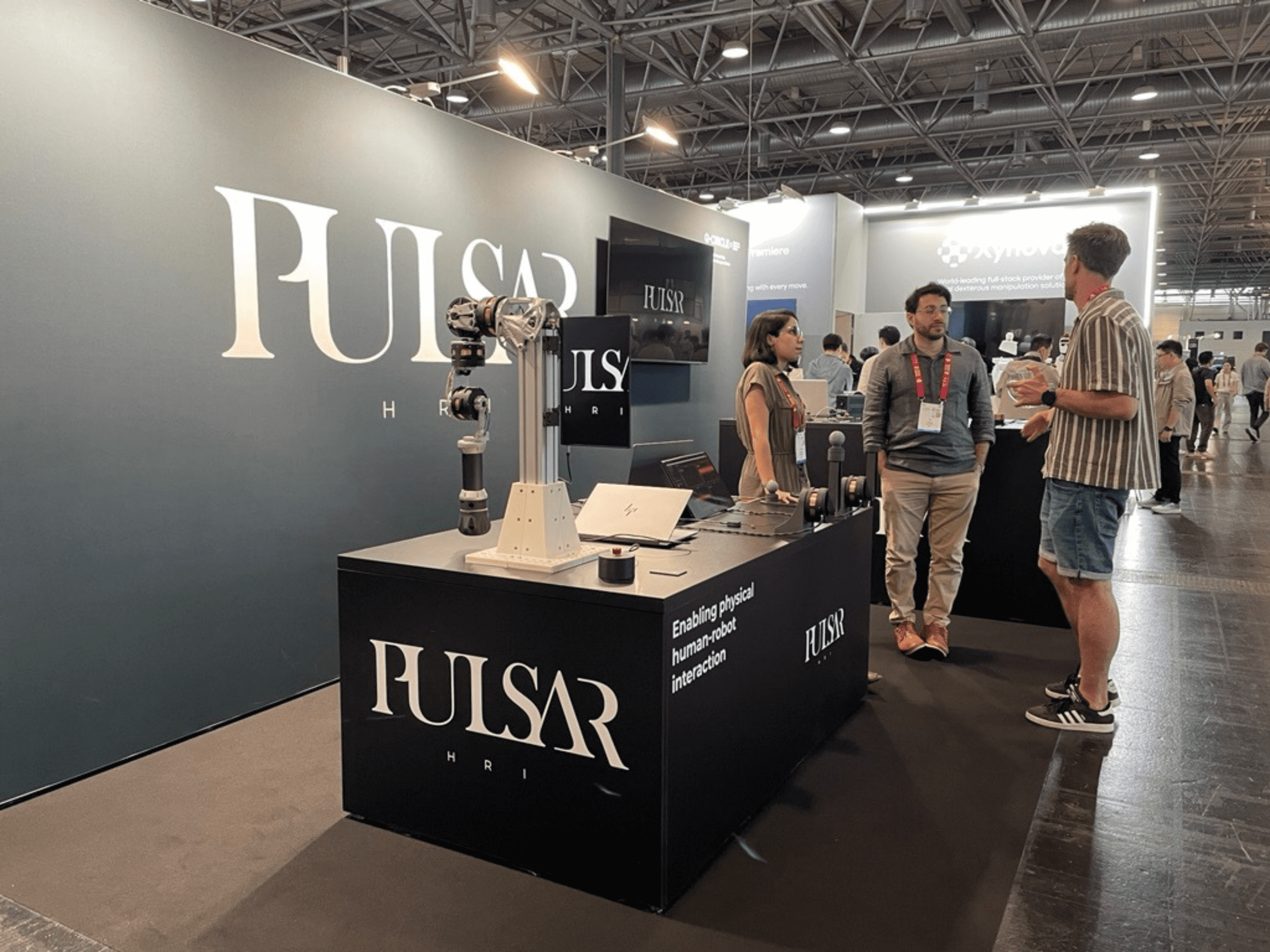
The company is presenting live demonstrations and a technical talk on bridging the gap between simulation and real-world robotic deployment
Vienna, June 2026. PULSAR HRI, the robotics division of ARQUIMEA, a Spanish technology company with more than 20 years of experience developing cutting-edge solutions in sectors such as aerospace and defense, is participating in the 2026 edition of the IEEE International Conference on Robotics and Automation (ICRA). During the event, PULSAR HRI is showcasing its latest developments in teleoperation, intelligent control, high-performance robotic actuation, and digital twin technologies designed to accelerate the deployment of next-generation robotic systems.
At Booth 012, attendees have the opportunity to experience a new teleoperation demonstration designed to achieve a higher level of transparency between human operators and robotic systems. The solution enables more natural, intuitive, and precise interaction, enhancing operator perception and control of remote robotic platforms.
PULSAR HRI is also presenting a new robotic arm demonstration developed to explore what true system-level agility feels like in practice. The platform combines advanced actuation and control capabilities to deliver backdrivability when needed, firmness at operational boundaries, and energy efficiency by design, providing a hands-on experience of agile, high-performance robotics.
One of the key highlights of the technologies on display is the ability to train and validate systems within high-fidelity digital twins and deploy them directly onto physical hardware without retraining. This approach accelerates development cycles, reduces deployment uncertainty and brings agile robotic systems closer to real-world applications.
As part of the ICRA 2026 technical program, PULSAR HRI also participated in the Tech Talk Stage with the presentation “Addressing the Sim-to-Real Gap,” which took place on June 2 at 12:45 PM in Hall C6/C7.
During the session, Miguel López, Director at PULSAR HRI, explained how combining accurate actuator modeling with real hardware validation enables the creation of high-fidelity digital twins that integrate seamlessly into modern robotics workflows. The talk highlighted how these technologies help accelerate robotic development, reduce uncertainty during deployment, and enable a faster transition from laboratory environments to real-world applications.
ARQUIMEA’s participation in ICRA 2026 reinforces the company’s commitment to advancing robotics technologies and contributing to the global innovation ecosystem through research, development and collaboration.
Where to Find Us
Event: IEEE International Conference on Robotics and Automation (ICRA) 2026
Location: Vienna, Austria
Booth: 012
Visitors attending ICRA 2026 are invited to discover the live demonstrations, meet the ARQUIMEA team, and explore the technologies shaping the next generation of robotic systems.