- Sectors
- Aerospace & Defense
- Big science
- Fintech
- Insights
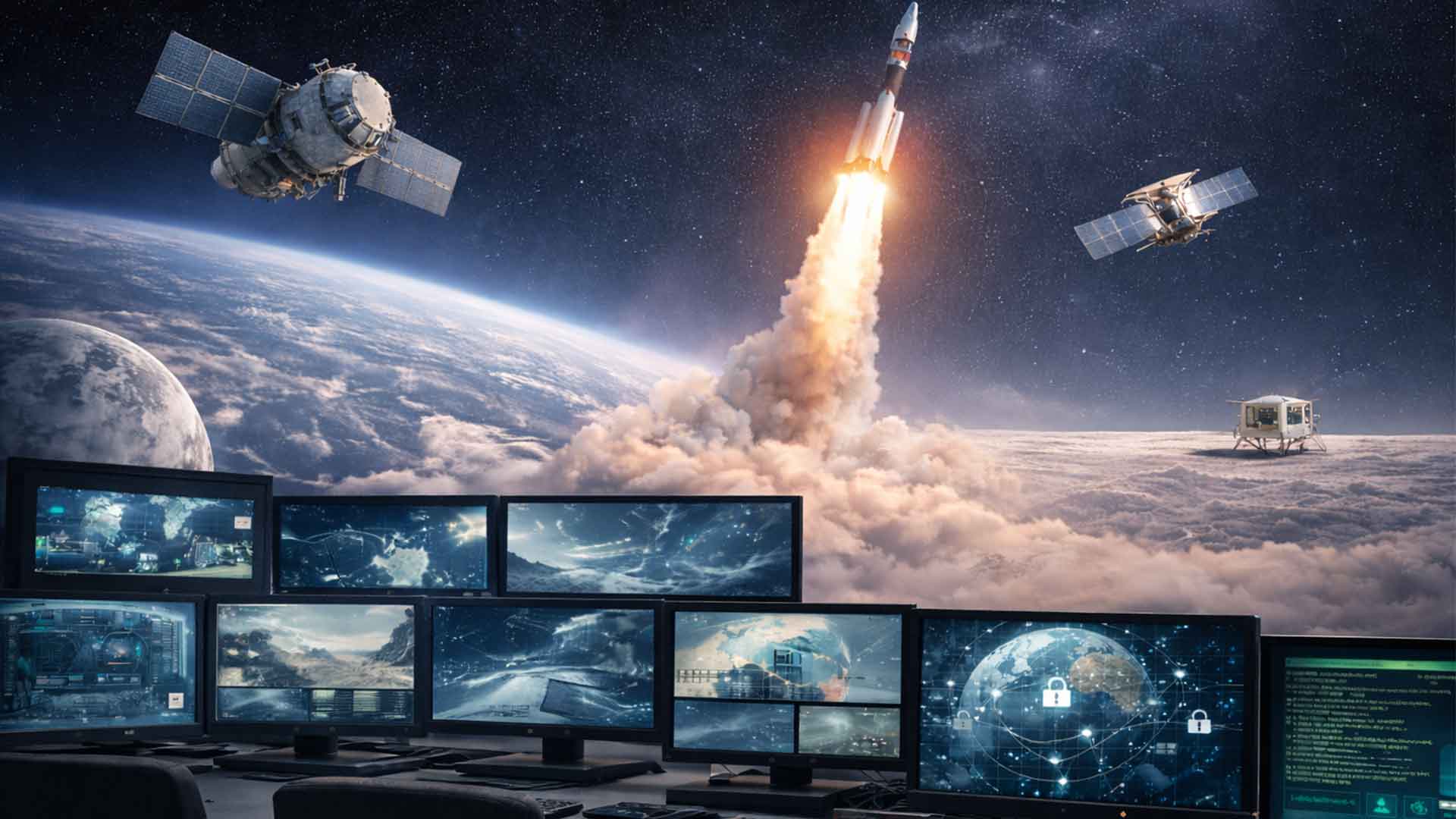
The space and defense trends toward 2026 reflect a clear shift in focus to operational capability, autonomy, and long-term system reliability in complex environments. Beyond the development of new technologies, the focus is increasingly on the ability to operate complex systems with reliability, autonomy, and continuity in demanding environments.
Looking ahead to 2026, both fields share structural challenges such as growing technical complexity, distributed operations, and reliance on interconnected systems. In this context, mission-oriented engineering and industrial capability are emerging as key factors in ensuring performance across the entire life cycle.
The space sector is evolving toward a more operational model, where differentiation no longer lies solely in access to orbit, but in the ability to design, deploy, and operate space systems in a sustained manner.
The deployment of large constellations is transforming access to connectivity and data services on a global scale. The main challenge shifts to coordinated operations, where fleet management, service continuity, and system resilience are decisive. Through CanarySat, we are developing a constellation of satellites in LEO orbit to deliver resilient and sovereign communications.
Advances in miniaturization, onboard electronics, and system integration are enabling compact platforms to take on increasingly demanding missions. This supports more flexible and scalable architectures, shortens development timelines, and facilitates the deployment of constellations in low Earth orbit.
As space becomes established as critical infrastructure, technological sovereignty is taking on increasing importance. Having in-house capabilities in key technologies is essential to ensure security, control over critical systems, and operational continuity.
Lunar activity is entering a new phase defined both by the return to the Moon and by the need to operate sustainably in an extreme environment. Limited communications, high levels of autonomy, and long-term reliability make the lunar environment a key setting for exploration and for the validation of critical technologies.
All of these trends converge on autonomy as an essential operational capability. Space systems must be able to manage anomalies and adapt to changing conditions without constant ground intervention, reinforcing resilience as a key design criterion.
In defense, the evolution follows a similar path. Priority is shifting toward real operational capability, where system integration, deployment, and sustainment are decisive.
Production, scalability, and industrial resilience are becoming established as strategic factors. Industry is increasingly an active part of the defense system, ensuring availability and sustained response capability.
Artificial intelligence is moving toward integration into concrete operational functions, such as decision support, sensor management, and increased platform autonomy. Its value lies in reliable and secure integration into critical systems.
Uncrewed platforms are evolving toward coordinated and swarm-based operational models. This approach increases flexibility and reduces risk, but requires high levels of autonomy, coordination, and integration with other capabilities.
Modern operations are conducted simultaneously across multiple domains. Interoperability and secure information sharing are becoming essential requirements for operational effectiveness.
Cybersecurity is no longer merely a cross-cutting concern, but has become an operational pillar. Resilience against cyber threats is integrated from the earliest design phases, on par with the physical protection of systems.
The trends shaping the space and defense sectors toward 2026 reflect a shared priority: having systems capable of operating with reliability, autonomy, and continuity in complex and demanding environments. The challenge is no longer only to develop advanced technology, but to integrate it and sustain it operationally over time.
From an industrial and engineering perspective, the space and defense trends toward 2026 reinforce the need for a mission-oriented vision, in which autonomy, interoperability, and resilience are built in from the design phase. In this context, ARQUIMEA addresses these challenges through cross-cutting experience in space and defense, with a focus on taking technologies from design and industrialization through to their operational integration under demanding requirements.