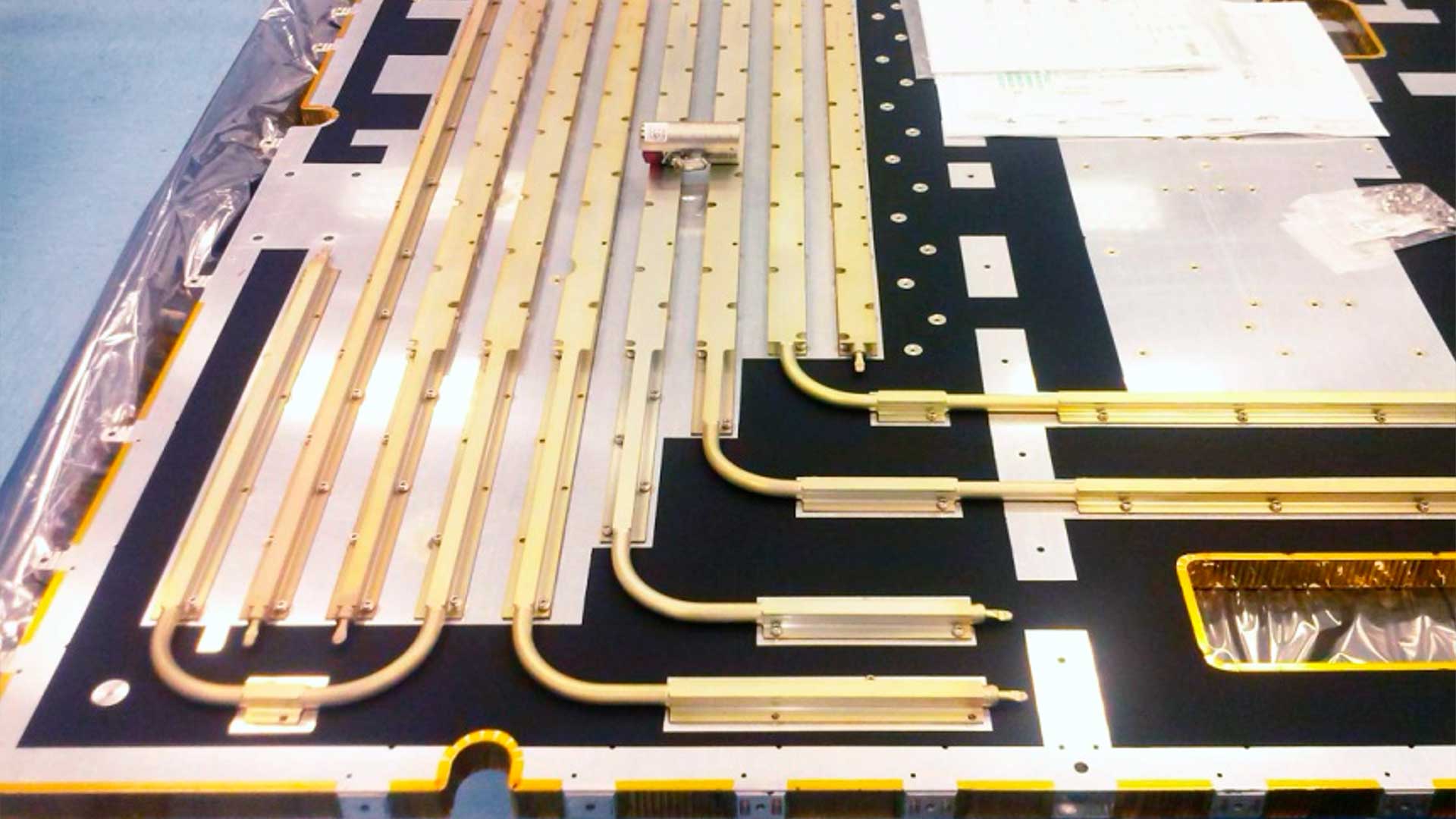
In space, temperature isn’t just an environmental condition, it’s a technological challenge. The absence of atmosphere eliminates natural convection, while direct solar radiation and deep shadow regions can generate severe thermal conditions. Unlike terrestrial environments, where multiple mechanisms exist to dissipate or regulate heat, space thermal control must rely on highly reliable solutions capable of operating for years without maintenance.
In this context, heat pipes, passive devices that transfer heat through the latent heat associated with phase changes of an internal working fluid, have become a key component in the thermal architecture of satellites and space missions. Their ability to transfer heat efficiently, without moving parts and with high reliability, makes them an essential solution for maintaining systems within safe operating temperature ranges.
However, the performance of heat pipes in space does not depend solely on their structural design. The working fluid circulating inside them ultimately determines their thermal behavior. In the space sector, ammonia has become one of the most widely used working fluids in heat pipes, as it provides highly efficient thermal performance within the temperature range in which these systems typically operate.
What Are Heat Pipes?
Heat pipes are hermetically sealed, two-phase heat transfer devices designed to transport high heat fluxes with minimal temperature gradients. Their operation is based on the phase change of a working fluid contained inside and on the action of a capillary structure that provides the driving force required to circulate the fluid and sustain the evaporation–condensation cycle.
Operating Principle
From a physical standpoint, the operation of a heat pipe is based on three main processes:
- Evaporation: the working fluid absorbs heat and vaporizes in the high-temperature region.
- Vapor transport: the generated vapor flows naturally toward the colder region, carrying heat with minimal losses.
- Condensation and capillary return: in the condenser, the vapor releases latent heat and condenses. The resulting liquid returns to the evaporator through the capillary structure. This mechanism enables operation in microgravity conditions.
Heat pipes are fully passive systems: they do not require pumps, compressors, or external power input. Fluid circulation is driven solely by internal pressure differences and capillary forces. This architecture eliminates mechanical wear mechanisms, resulting in long operational lifetimes and extremely high reliability.
Advantages Over Other Thermal Control Systems
Compared to solid conduction-based solutions or active cooling systems, heat pipes offer clear advantages:
- Ability to transport high heat fluxes with minimal temperature gradients
- Uniform heat distribution across satellite structures
- No vibrations or mechanical interference
- Stable operation in microgravity thanks to capillary-driven return
- Lower structural complexity and reduced mass compared to active systems
In space platforms, where constraints on mass, volume, and power consumption are critical, these characteristics make heat pipes a technically superior solution for passive thermal management. In the absence of convection, heat can only be managed through conduction and radiation, further reinforcing their role within spacecraft thermal control architectures.
The Role of the Working Fluid in a Heat Pipe
The working fluid is the core element of a heat pipe. Its thermodynamic behavior enables the evaporation–condensation cycle that allows heat to be transferred with high efficiency. Without a properly selected fluid, the device cannot operate as a stable two-phase system.
There is a direct relationship between the chosen fluid and the operating temperature range. Internal pressure, phase change temperature, latent heat, and compatibility with the pipe materials all determine overall performance. A fluid optimized for the intended thermal range maximizes heat transport capability while minimizing temperature gradients.
For this reason, fluid selection is not a secondary consideration but a key design parameter that must be aligned with mission requirements and the expected thermal environment.
Advantages of Ammonia Over Other Fluids
Within standard temperature ranges for space applications, ammonia is considered the reference working fluid for heat pipes. Its thermodynamic properties provide an optimal balance between phase change temperature, operating pressure, and latent heat, enabling the transport of significant heat loads with minimal temperature gradients.
Its high heat transfer efficiency is driven by its elevated latent heat and favorable properties for stable evaporation and condensation cycles. This results in predictable thermal behavior and an excellent capacity to redistribute heat across satellite structures.
From an operational perspective, ammonia also offers suitable stability within its working range and well-established compatibility with materials commonly used in space applications.
As a result, for missions operating within standard temperature ranges, ammonia provides the best balance between performance, stability, and reliability, which explains its widespread use in space platforms.
Other Fluids Depending on the Thermal Range
Although ammonia is the most efficient option within standard temperature ranges, the selection of the working fluid always depends on the expected thermal environment.
For very low-temperature applications, fluids such as propylene or ethane are used, as they can operate reliably under conditions where ammonia would not be optimal or even viable. At the opposite end, for high-temperature ranges, toluene becomes a suitable alternative due to its phase-change properties at elevated temperatures.
Water, despite its widespread use in terrestrial applications, is not suitable for these systems when there is a risk of temperatures below 0 °C. Freezing can cause internal expansion, potentially compromising the integrity of the sealed vessel and leading to structural damage.Therefore, fluid selection is strictly driven by the mission’s thermal range, with ammonia remaining the most efficient solution when operating under standard conditions.
At ARQUIMEA, we bring over 20 years of experience in the development of thermal solutions for high-demand space and industrial applications, designing and manufacturing heat pipes tailored to the specific requirements of each mission and operating range. Our expertise enables us to deliver systems optimized for performance, reliability, and durability, in line with the most demanding industry standards.