- Sectors
- Aerospace & Defense
- Big science
- Fintech
- Insights
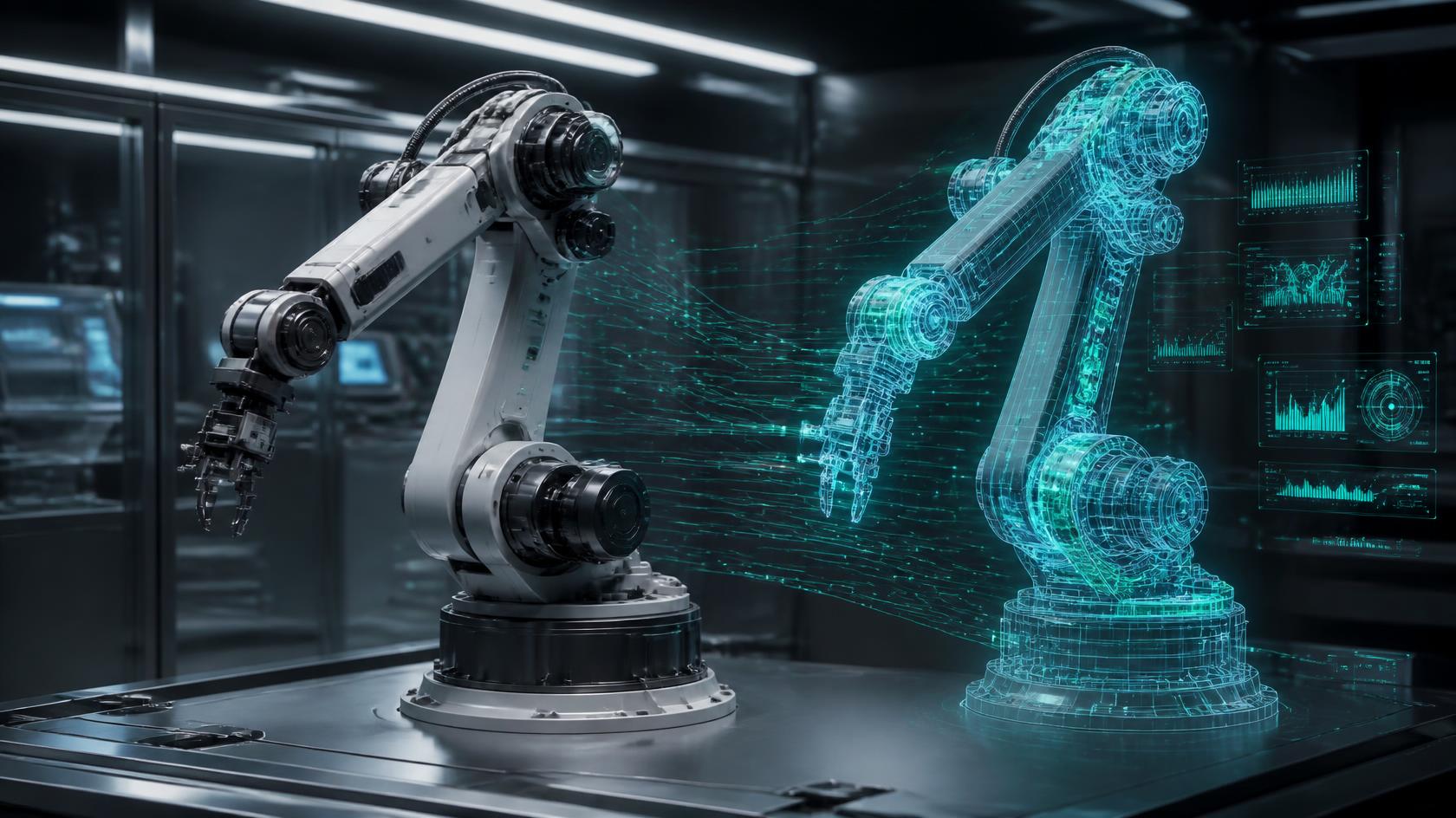
Before manufacturing a machine, operating an energy system, or even making certain decisions about our planet, what if we could first test what might happen using a digital replica capable of behaving much like the real system?
This possibility has been used in engineering for years, but it is now reaching an entirely different scale. Today, there are digital twins of factories, engines, robots, and infrastructure, while projects such as Destination Earth are taking the concept much further: creating digital replicas of Earth systems to support research and decision-making.
The evolution is significant. A technology originally conceived to better understand the behavior of industrial systems is now finding applications in medicine, robotics, climate research, and space exploration. Behind all of them lies the same idea: experimenting first on a sufficiently accurate digital representation can help anticipate behavior, evaluate scenarios, and reduce the cost and risk of experimenting directly on the physical system.
But achieving this requires much more than building a good 3D model. A true digital twin is considerably more complex.
A digital twin is a virtual representation of a physical object, process, or system that uses models and data to reproduce its behavior and evolve alongside it. The fundamental difference between a digital twin and a conventional simulation lies precisely in this connection to reality.
A simulation can represent how a system should behave under certain conditions. A digital twin goes further by incorporating information from its physical counterpart, such as sensor data, operating conditions, or experimental results, to update its state and progressively improve the correspondence between the two worlds. This relationship can be bidirectional, allowing the model to be used to evaluate decisions before applying them to the real system. This dynamic, connected approach is also reflected in the scientific literature on digital twins in fields such as medicine.
Its architecture typically combines three elements. First, there is the physical system, which can range from an actuator to an entire infrastructure. Second, there is its digital representation, built using physical, mathematical, or data-driven models. Between them lies an information layer that keeps the two states connected.
The greater the fidelity of this relationship, the greater the potential of the twin. It is no longer limited to visualizing what is happening; it can also be used to ask what will happen next or what might happen if certain conditions are changed.
That is where much of its value lies.
One of the most established applications of digital twins is in industry. Sensors installed in machinery can feed models that track variables such as temperature, vibration, energy consumption, or wear. By comparing expected behavior with observed behavior, anomalies can be detected and certain failures anticipated before they cause downtime.
However, the concept has evolved far beyond predictive maintenance.
During the design of a system, a digital twin can be used to explore different configurations before physical components are manufactured. Once the system has been built, the twin can help optimize its operation. And throughout its service life, data collected from the real system can be fed back into the model to progressively improve its predictive capabilities.
The result is a continuous cycle of design, simulation, experimentation, and operation. Rather than waiting for a prototype to be built before discovering its limitations, part of that learning process can take place in the virtual environment.
This idea has particularly interesting precedents in the history of space exploration. Following the Apollo 13 accident, NASA used simulators and models of the spacecraft to recreate the conditions of the damaged vehicle and test possible solutions on Earth before communicating them to the astronauts. NASA itself identifies these approaches as conceptual predecessors of today’s digital twins.
More than half a century later, the underlying principle remains recognizable: use a sufficiently accurate representation of a physical system to experiment where doing so on the real object would be too expensive, too slow, too dangerous, or simply impossible.
When the Digital Twin enters the laboratory
What is particularly interesting is that this logic is moving beyond industrial environments. Digital twins are beginning to be used as scientific tools for studying systems whose complexity makes direct experimentation difficult.
One of the most ambitious examples is Destination Earth (DestinE). This European initiative is developing high-precision digital twins of the Earth system by combining real-time observations, high-resolution predictive models, artificial intelligence, and high-performance computing. Its initial applications include climate change adaptation and the simulation of extreme weather events.
The scale of the project illustrates just how far the concept can go. Rather than reproducing a machine, the aim is to represent interactions between the atmosphere, oceans, land surface, and human activity in order to explore scenarios that can support decision-making before certain events occur.
Biomedicine presents an entirely different challenge. Researchers are working on models capable of representing organs, physiological processes, or even the specific characteristics of an individual patient. The long-term goal would be to use these replicas to simulate disease progression or anticipate the response to an intervention before it is applied.
However, biological variability, data availability, and the need for rigorous model validation make this field considerably more complex than many industrial applications. A recent review highlights that the credibility and validation of these models will be essential if they are to move from basic and preclinical research toward broader biomedical applications.
Digital twins are therefore evolving from representations of relatively well-defined objects toward attempts to reproduce complex, dynamic, multiscale systems.
A digital twin is only as useful as the model it contains and the data that feeds it.
Sensors provide information about the state of the physical system. Mathematical models describe the relationships between its variables. Simulation reproduces its evolution and, increasingly, artificial intelligence helps identify patterns that are difficult to capture using purely deterministic models.
Combining these approaches is giving rise to hybrid digital twins. A physics-based model can provide consistency and interpretability, while machine learning methods can capture behaviors that are difficult to model or correct discrepancies between simulation and reality.
But increasing complexity does not automatically result in a better digital twin. For its predictions to be useful, it is essential to continuously assess how accurately they represent the real behavior of the system. Verification, validation, and uncertainty quantification are therefore central considerations.
This becomes particularly important when a digital twin moves beyond optimizing a machine and begins informing decisions related to healthcare, critical infrastructure, or environmental phenomena. In these scenarios, knowing how much confidence can be placed in a prediction is almost as important as the prediction itself.
Robotics is one of the areas where this technology is showing particularly significant potential.
Training a robot directly on physical hardware has obvious limitations. Testing takes time, causes wear, and can result in damage when experimenting with movements, controllers, or strategies that are still under development. Simulation makes it possible to multiply the number of experiments, but introduces another well-known challenge: the sim-to-real gap, the difference between how a robot behaves in a virtual environment and how it responds when the same control strategy is transferred to physical hardware.
Digital twins seek precisely to reduce that gap.
To achieve this, the model must reproduce aspects that a simplified simulation may overlook, including friction, saturation effects, current and torque limits, transmission dynamics, sensor behavior, and the operation of internal controllers.
The more accurate this representation becomes, the greater the ability to design, train, and validate strategies in simulation before transferring them to the physical robot. A recent scientific review on robotic arms and reinforcement learning identifies digital twins as one of the technologies capable of improving the connection between virtual training and real-world manipulation.
This pursuit of simulation capable of predicting hardware behavior with greater accuracy lies at the heart of the work carried out by PULSAR HRI, ARQUIMEA’s technology unit specializing in advanced robotics technologies.
Its AUGUR ecosystem is built around an actuator-level digital twin designed to reproduce the electromechanical characteristics of PULSE actuators. The model incorporates aspects such as motor physics, transmission friction and dynamics, current and torque limits, integrated control loops, and sensor noise.
The difference can be measured. In tests conducted with the PULSE115 actuator, AUGUR reproduced position and torque dynamics with errors approximately one order of magnitude lower than those obtained using a simplified model. When the system was scaled to a virtual humanoid arm with four actuators, a 41-second motion sequence could be simulated in just over six seconds on a conventional laptop, while maintaining detailed modeling of actuator dynamics.
This capability makes it possible to test controllers, trajectories, and configurations before deploying them on physical hardware. In the development of the PULSE robotic arm, the virtual model is also used to evaluate mass, workspace, payloads, power consumption, structural optimization, and standardized accuracy and tracking metrics. In certain configurations, 36 different static positions and payloads of up to 3 kg were analyzed before completing the physical optimization of the system.
The result clearly illustrates how the concept of the digital twin is evolving. It is no longer simply about creating a digital replica that shows what a system looks like, but about providing an environment in which to design, experiment, validate, and anticipate how it will behave before building or physically modifying it.
From a factory to a robot, an organism, or even the planet itself, the scale may change dramatically, but the underlying logic remains the same. When a digital model maintains a sufficiently close relationship with reality, it stops being merely a representation and becomes a new tool for research.
And perhaps that is where the true potential of digital twins lies: not in copying the physical world, but in allowing us to experiment with it before intervening in reality.